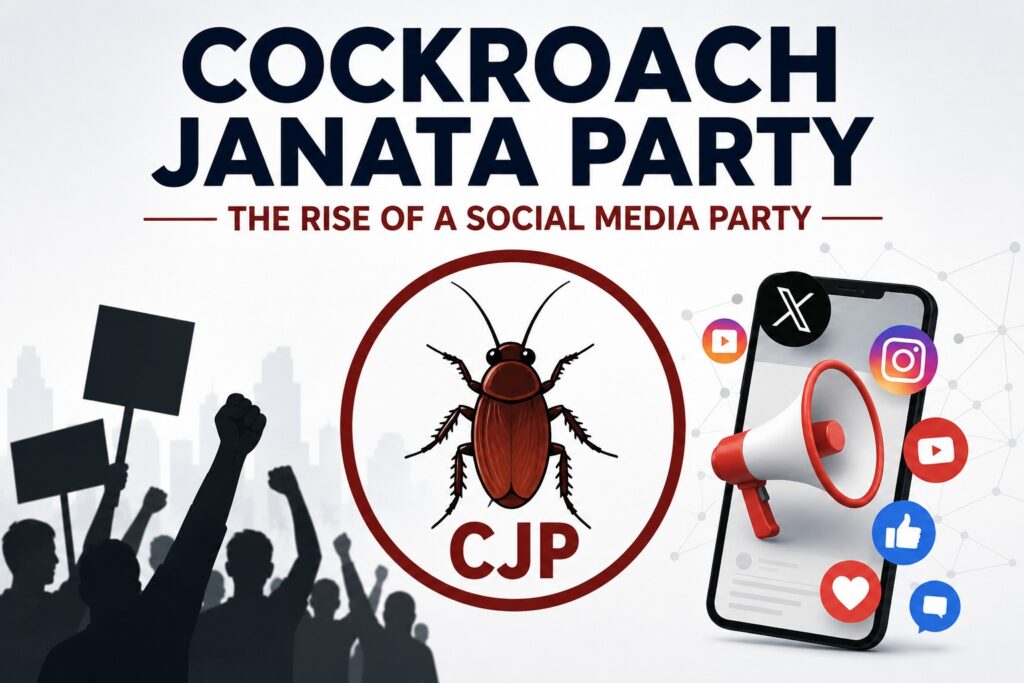

The Cockroach Janata Party (CJP) is a viral social media-based satirical political movement that emerged in India in 2026. Initially launched as an internet joke and protest campaign, it rapidly evolved into a digital platform expressing the frustrations of young Indians regarding unemployment, governance, economic uncertainty, and political representation.
Unlike conventional political parties, the CJP originated primarily through social media platforms such as Instagram and X (formerly Twitter), where memes, satire, short videos, and digital campaigns became its primary tools of communication.
The movement represents a growing phenomenon in which online communities use humor and symbolism to engage in political discourse.
Origin of the Movement
The emergence of the Cockroach Janata Party is linked to public outrage over remarks that were interpreted by many social media users as comparing unemployed youth to “cockroaches.”
In response, social media users transformed the term into a symbol of protest and resistance.
The movement’s founder, Abhijeet Dipke, created online platforms under the name “Cockroach Janata Party,” which quickly gained massive visibility among Gen Z audiences.
Why the Symbol of a Cockroach?
Traditionally viewed negatively, the cockroach was reinterpreted by supporters as a metaphor for survival, resilience, and adaptability.
Supporters argued that:
- Young people continue to struggle despite unemployment and economic pressures.
- The symbol represents ignored or marginalized sections of society.
- Satire can become a tool of political expression.
Thus, the cockroach evolved from an insult into a digital emblem of protest.
Key Features of the Movement
1. Social Media-Driven Politics
Unlike traditional political organizations that rely on party offices and ground-level cadres, CJP operates primarily through digital platforms.
Its growth demonstrates the increasing influence of social media in shaping political narratives.
2. Meme-Based Political Communication
The movement relies heavily on:
- Memes
- Short-form videos
- Internet humor
- Satirical political commentary
This reflects a broader shift in how younger generations consume political content.
3. Youth-Centric Messaging
The movement focuses on issues such as:
- Unemployment
- Competitive examination pressures
- Rising cost of living
- Governance concerns
- Political accountability
These themes resonate strongly with Gen Z and young voters.
4. Digital Activism
The CJP illustrates how online communities can mobilize public opinion without traditional organizational structures.
Why Did the Movement Go Viral?
Growing Youth Frustration
Many young citizens face challenges related to employment opportunities, education, and economic mobility.
The movement provided a relatable and humorous outlet for these concerns.
Power of Meme Culture
Humor often spreads faster than conventional political messaging.
The use of satire allowed complex issues to reach millions of users in a simplified format.
Anti-Establishment Sentiment
The movement attracted users dissatisfied with both ruling and opposition political narratives.
Algorithmic Amplification
Social media platforms amplified viral content, enabling rapid growth in followers and engagement.
Political and Social Significance
Rise of Digital Democracy
The movement demonstrates how citizens can participate in political conversations without formal institutional structures.
Evolution of Political Communication
Traditional rallies and speeches are increasingly being complemented by:
- Viral content
- Influencer-driven discourse
- Hashtag campaigns
- Digital communities
Reflection of Public Sentiment
Even if satirical, the movement highlights genuine concerns among sections of India’s youth population.
Criticisms and Limitations
Lack of Organizational Structure
Critics argue that online popularity does not necessarily translate into political influence.
Absence of Clear Ideology
The movement remains largely symbolic and issue-driven rather than policy-oriented.
Risk of Misinformation
Viral digital campaigns can sometimes spread incomplete or misleading information.
Sustainability Concerns
Many internet-driven movements experience rapid growth but struggle to maintain long-term momentum.
Broader Implications for Indian Democracy
The Cockroach Janata Party raises important questions:
- Can digital movements influence electoral politics?
- Will Gen Z reshape political communication?
- Can satire become a serious form of democratic participation?
- How should institutions respond to internet-driven political activism?
These questions are increasingly relevant in an era where political engagement is shifting from public squares to digital platforms.