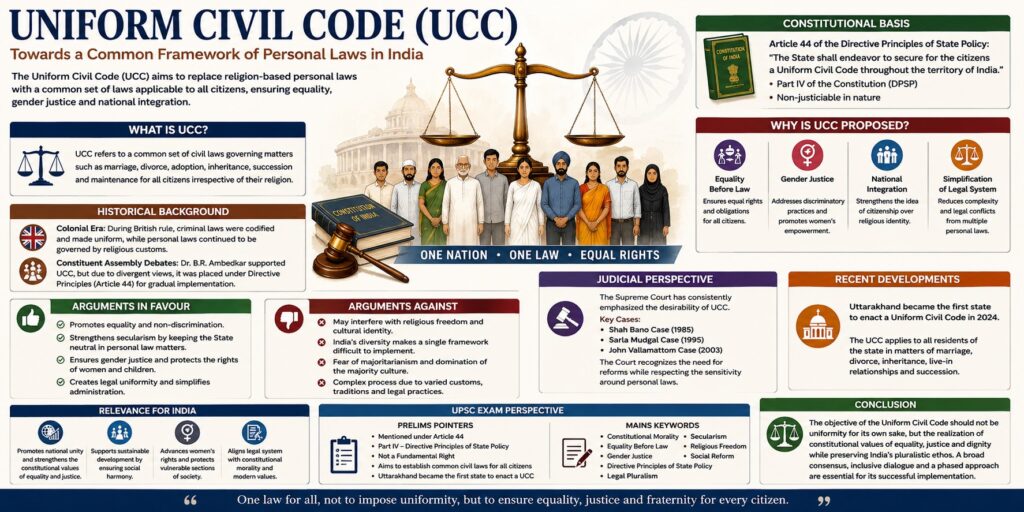

The Uniform Civil Code (UCC) refers to the idea of replacing religion-based personal laws governing matters such as marriage, divorce, adoption, inheritance, succession, and maintenance with a common set of laws applicable to all citizens irrespective of their religion.
The concept finds constitutional backing in Article 44 of the Directive Principles of State Policy (DPSP), which states:
“The State shall endeavor to secure for the citizens a Uniform Civil Code throughout the territory of India.”
Constitutional Basis
Article 44 – Directive Principles of State Policy
Article 44 encourages the State to work towards establishing a common civil code for all citizens.
However, since DPSPs are non-justiciable, courts cannot compel the government to implement a UCC.
Fundamental Rights Dimension
The debate surrounding UCC often involves balancing:
- Article 14 – Right to Equality
- Article 15 – Prohibition of Discrimination
- Article 25 – Freedom of Religion
- Article 26 – Religious Affairs of Denominations
Thus, UCC lies at the intersection of equality, secularism, and religious freedom.
Historical Background
Colonial Era
During British rule, criminal laws were largely codified and made uniform, while personal laws related to family matters continued to be governed by religious customs.
Constituent Assembly Debates
The issue generated significant debate during the framing of the Constitution.
Dr. B.R. Ambedkar supported the idea of a common civil code while emphasizing that implementation should be gradual and democratic.
Consequently, UCC was placed under the Directive Principles rather than being made an enforceable Fundamental Right.
Why is the Uniform Civil Code Proposed?
1. Equality Before Law
Different personal laws sometimes provide different rights and obligations to citizens based on religion.
A common code is seen as a means to ensure equal treatment under the law.
2. Gender Justice
Many advocates argue that a uniform legal framework can help eliminate discriminatory practices affecting women in matters such as inheritance, maintenance, and divorce.
3. National Integration
A common civil law framework may strengthen the idea of citizenship over religious identity.
4. Simplification of Legal System
Multiple personal laws often create complexity and legal ambiguities.
A uniform framework could streamline legal procedures and improve judicial efficiency.
Arguments in Favour of UCC
Promotes Equality
All citizens would be governed by the same civil laws regardless of religion.
Strengthens Secularism
The State would maintain neutrality in personal law matters.
Ensures Gender Justice
Uniform provisions could reduce discrimination and enhance women’s rights.
Legal Uniformity
It could simplify administration and reduce legal conflicts arising from diverse personal laws.
Arguments Against UCC
Religious Freedom Concerns
Critics argue that personal laws are closely linked to religious practices and cultural identity.
Diversity of India
India’s social and cultural diversity makes a single framework difficult to implement.
Fear of Majoritarianism
Some communities fear that a common code may reflect the customs of the majority rather than genuine uniformity.
Implementation Challenges
Reconciling diverse customs, traditions, and legal practices is a complex task.
Judicial Perspective
The Supreme Court has repeatedly highlighted the desirability of a Uniform Civil Code in several judgments:
Key Cases
- Shah Bano Case (1985)
- Sarla Mudgal Case (1995)
- John Vallamattom Case (2003)
The Court has often emphasized the need for legal reforms while recognizing the sensitive nature of personal laws.
Recent Developments
Uttarakhand’s UCC
In 2024, Uttarakhand became the first Indian state to enact a Uniform Civil Code, creating a common legal framework for matters such as marriage, divorce, inheritance, and live-in relationships within the state.
This development has reignited the national debate on implementing a UCC at the national level.
Relevance for India
The UCC debate is not merely legal but also social, political, and constitutional.
Its implementation requires balancing:
- Equality and Justice
- Religious Freedom
- Cultural Diversity
- Constitutional Morality
The challenge lies in ensuring that reforms are inclusive, consultative, and respectful of India’s pluralistic character.