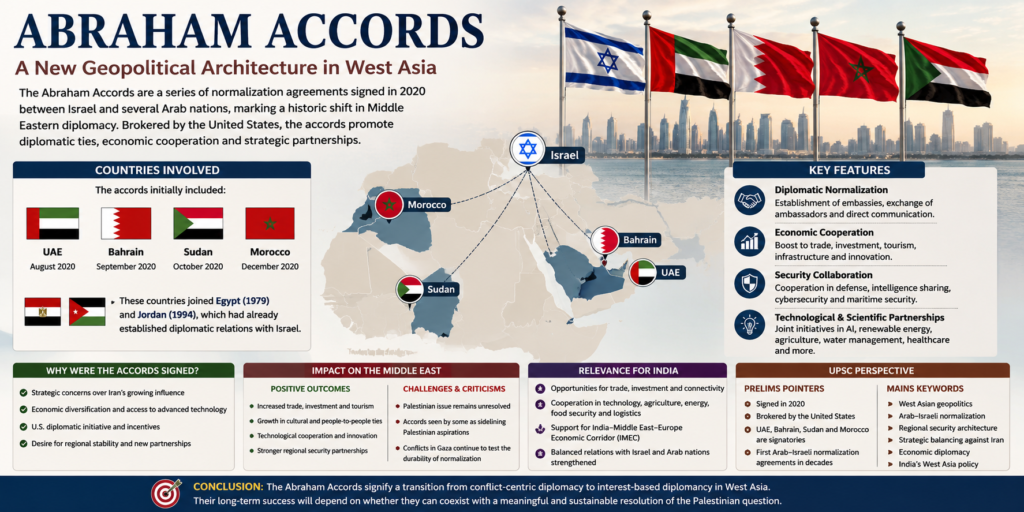

The Abraham Accords are a series of normalization agreements signed in 2020 between Israel and several Arab nations, marking a historic shift in Middle Eastern diplomacy. Brokered by the United States under the administration of President Donald Trump, the agreements sought to establish formal diplomatic relations, economic cooperation, and strategic partnerships between Israel and Arab states.
The term “Abraham” refers to the Prophet Abraham, who is revered in Judaism, Christianity, and Islam, symbolizing a shared religious heritage among the signatory nations.
Countries Involved
The accords initially included:
- United Arab Emirates (UAE) – August 2020
- Bahrain – September 2020
- Sudan – October 2020
- Morocco – December 2020
These countries joined Egypt (1979) and Jordan (1994), which had already established diplomatic relations with Israel.
Historical Significance
For decades, most Arab nations refused to normalize relations with Israel until the Palestinian issue was resolved. The Abraham Accords represented a departure from this traditional Arab consensus.
The agreements demonstrated a shift from an ideology-driven approach to a strategic and interest-based foreign policy centered on:
- Economic cooperation
- Technological partnerships
- Security collaboration
- Countering regional threats, particularly Iran
Key Features of the Accords
1. Diplomatic Normalization
Countries established embassies, exchanged ambassadors, and opened direct communication channels.
2. Economic Cooperation
The accords encouraged trade, investment, tourism, innovation, and infrastructure development.
3. Security Collaboration
Signatories increased cooperation in defense, intelligence sharing, cybersecurity, and maritime security.
4. Technological and Scientific Partnerships
Joint projects were launched in sectors such as:
- Artificial Intelligence
- Renewable Energy
- Agriculture
- Water Management
- Healthcare
Why Were the Abraham Accords Signed?
Strategic Concerns over Iran
Many Gulf states viewed Iran’s regional influence as a major security challenge. Closer cooperation with Israel provided a framework for collective security.
Economic Diversification
Countries such as the UAE sought advanced technologies and investment opportunities to reduce dependence on oil revenues.
U.S. Diplomatic Initiative
The United States played a central role in facilitating negotiations and providing incentives to participating nations.
Impact on the Middle East
Positive Outcomes
- Increased regional trade and investment.
- Growth in tourism and cultural exchanges.
- Enhanced technological cooperation.
- Strengthened regional security partnerships.
Challenges and Criticisms
- The Palestinian issue remains unresolved.
- Critics argue that the accords sidelined Palestinian aspirations for statehood.
- Periodic conflicts in Gaza continue to test the durability of normalization efforts.
Relevance for India
India maintains strong relations with both Israel and the Arab world. The Abraham Accords have created new opportunities for trilateral and multilateral cooperation involving India.
Strategic Importance for India
- Enhanced connectivity and trade routes.
- Greater opportunities in technology and innovation.
- Cooperation in food security, energy security, and logistics.
- Strengthening of the India–Middle East–Europe economic corridor.
The accords complement India’s vision of deeper engagement with West Asia while maintaining balanced relations with all regional stakeholders.